We teach AWS for the real world - not for certifications. Join more than 10,500 developers learning how to build real-world applications on AWS.
AWS analytics feels slow by default
⏱️
Reading time: 21 minutes
🎯
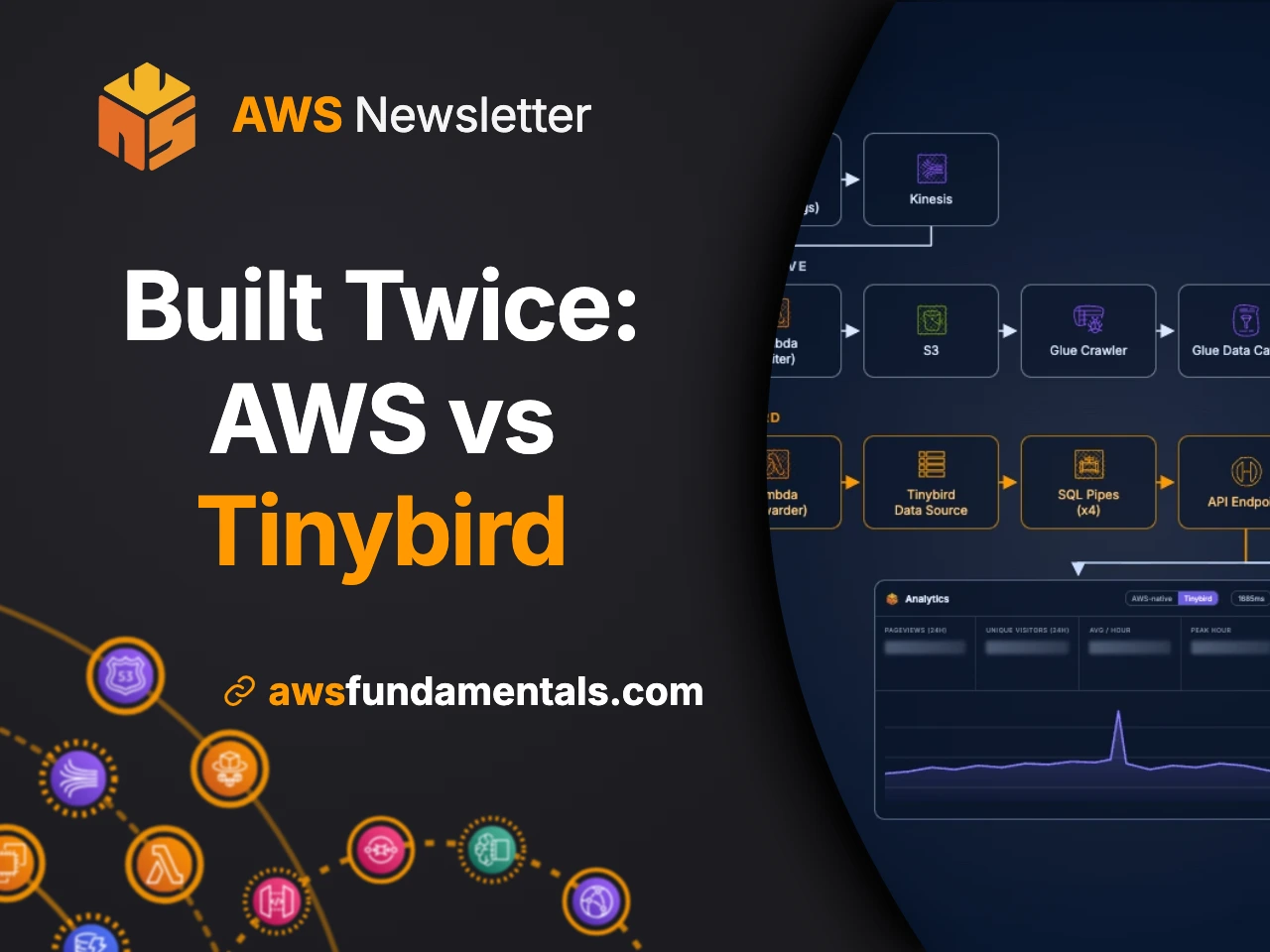
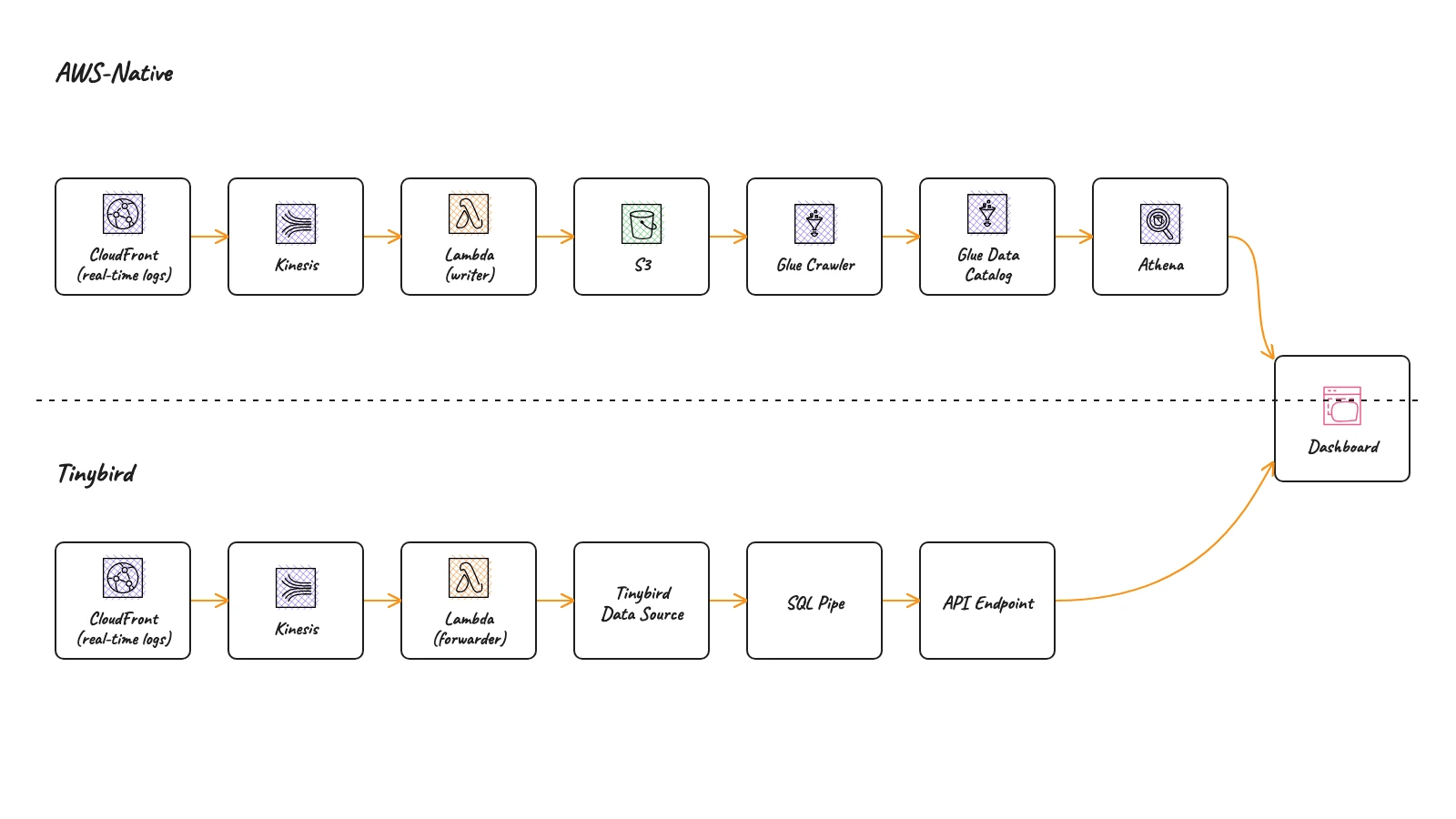
Main Learning: Same CloudFront logs: 12.5s through Kinesis, S3, Glue and Athena, about 1s through Tinybird's
managed ClickHouse.
Hey Reader 👋🏽 We've been running Plausible for the analytics on awsfundamentals.com. Good software, no complaints. We still wanted the data to be ours: our retention, our schema, nobody's script in the visitor's browser. So we built the dashboard ourselves. Twice, on two different backends, fed by the same CloudFront logs. Then we measured both instead of arguing about them. In this issue: what AWS-native analytics actually costs in seconds and in dollars, and where it holds up fine. Sponsored by Tinybird. This issue's deep dive was done in collaboration with them, and every number in it is measured from our own setup.
The honest takeaway: AWS-native isn't broken, it's just cold every single time. You can fix that yourself with a cache layer and Partition Projection, and then you own a cache layer. See you next week! 🙏 Tobi & Sandro
|

AWS for the Real World
We teach AWS for the real world - not for certifications. Join more than 10,500 developers learning how to build real-world applications on AWS.
AWS FOR THE REAL WORLD ⏱️ Reading time: 10 minutes 🎯 Main Learning: Every convenience layer AWS built on ECS is dead or dying, while ECS itself has not changed since 2014. Build on the primitive, and make the layer above it prove itself first. 📝 Blog Post Hey Reader 👋🏽 Getting started with an AWS service often feels more complicated than it should. Four concepts must be understood before a single container runs. A VPC is required before a single request. So, the fancy CLI that promises to do...
AWS FOR THE REAL WORLD ⏱️ Reading time: 11 minutes 🎯 Main Learning: A Karpenter NodePool is a placement policy, not an instance preference. Pin one instance family, and a Spot shortage moves your fleet across availability zones, where every internal call starts costing $0.01 per GB. 📝 Blog Post Hey Reader 👋🏽 Important off topic things first: Sandro got married! 🎉We were in Munich for it and it was a fantastic day! ☀️Highly recommend a wedding over sprint planning or fighting with AWS...
AWS FOR THE REAL WORLD ⏱️ Reading time: 6 minutes 🎯 Main Learning: One stack, reused for every project. Hono on Lambda, Postgres with Drizzle, a TanStack SPA on S3 and CloudFront, and Better Auth for login. 📝 Blog Post Hey Reader 👋🏽we've build a lot of fullstack applications so far: client projects side projects (this one, shopify apps, etc.) example tutorial apps Over the past few years we switched up tech stacks a lot. That taught us what actually matters in a stack and what is just...