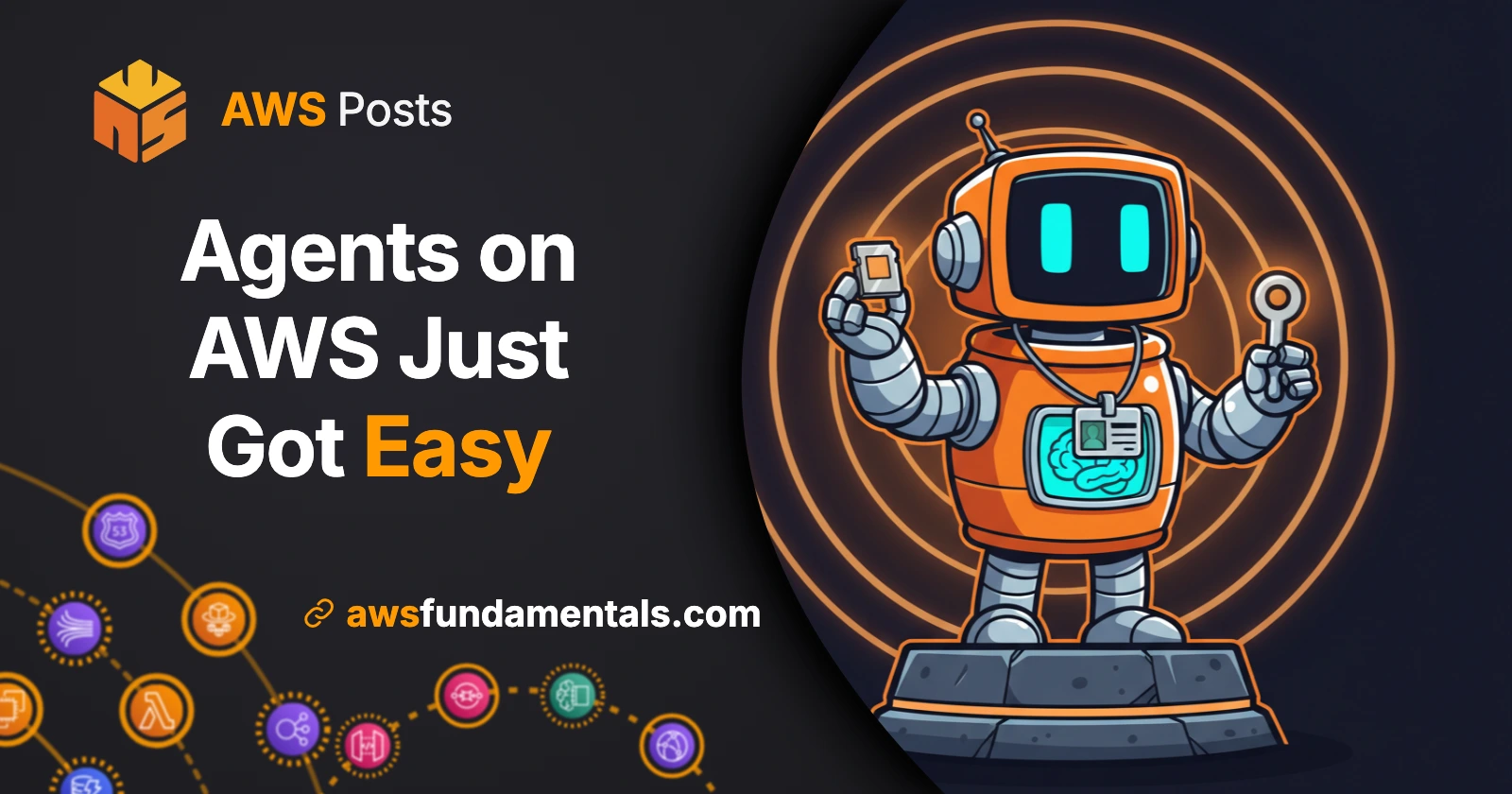
Building Agents on AWS Just Got a Lot Easier


AWS FOR THE REAL WORLD
⏱️
Reading time: 10 minutes
🎯
Main Learning: Describe the agent: model, prompt, tools and AWS runs the orchestration loop behind one API call!
📝

Hey Reader 👋🏽

If you've ever built an agent on AWS, you know the pain: glue Bedrock, Lambda, and DynamoDB together, grab LangGraph or Strands, then also own the orchestration loop, the memory layer, and your own tracing. 😅

A "simple" agent ends up with multiple layers of pain.
AWS just shipped something that takes most of that off our plate!

The AgentCore harness gives you a fully-managed agent runtime. You describe the agent: model, system prompt, tools and AWS does all the rest! 💪
In this issue, we look at what the harness actually gives you, what it costs, and where it may still fall a little bit short!

AWS AgentCore harness

📚 This Week's Deep Dive

Building an agent on AWS today means picking a framework, writing the orchestration loop, packaging it as a Docker image or code bundle, and wiring up your own state, memory, and tracing. AgentCore (since October 2025) already solved a lot of that: managed runtime, memory, gateway, identity, observability. But one thing stayed on you: writing the agent code yourself.

The harness removes that last piece. It sits one layer above Runtime. No loop to write, no container to push. You describe the agent via the model, system prompt and tools and AWS runs the orchestration on top! Under the hood it's powered by Strands Agents, but you don't need to know that to use it.

What you get out of the box

A per-session microVM with its own filesystem and shell. Multi-provider models: any Bedrock model, OpenAI, or Google Gemini, with provider switching mid-session. Server-side memory keyed by runtimeSessionId. Built-in tools (browser, code interpreter, MCP, Gateway). And a response stream that is structured observability! You see why the agent called a tool, the params it sent, and what came back, no tracing SDK bolted on.

The 20-line agent

Once the harness is configured in the console, invoking it is tiny. You call InvokeHarnessCommand with the harness ARN, a runtimeSessionId, and the current user message, then read text chunks off the stream. No Lambda packaging, no Docker image, no DynamoDB schema, no conversation history sent by hand. The harness threads it server-side. The session ID is the only state you keep.

The full post walks through configuring a harness in the console, the complete SDK example, and the pricing table line by line.

📰 This Week in AWS

📦AWS ExtendDB: a DynamoDB-compatible adapter, open source

If you've ever wanted real DynamoDB behavior on your laptop or on-prem without rewriting code, this is it. ExtendDB 0.1 implements the DynamoDB API with pluggable storage backends (PostgreSQL is the reference). Apache 2.0, community-driven, good for local dev and CI. Read More →

🔄AWS SDKs are changing how they retry

Retry behavior is going consistent across every SDK: 50ms base delay, a stricter retry quota so calls fail fast during outages instead of hanging, and DynamoDB drops to 4 max attempts. Default in November 2026, opt in now! Read More →

That's it for this week.
If you build anything on AWS, those SDK retry changes are worth a quick test run before November turns them on by default!
Also: go spin up a harness and tell us what you build with it! 👀

See you soon!

Sandro & Tobi

AWS for the Real World

We teach AWS for the real world - not for certifications. Join more than 10,500 developers learning how to build real-world applications on AWS.
Read more from AWS for the Real World

⏱️ Reading time: 15 minutes 🎯 Main Learning: A public container on AWS for $7 a month, with no VPC to own. 📝 Blog Post 🤝 Sponsored by AWS. What we built, what it cost and what we think of it are our own. Hey Reader 👋🏽 Your first container on ECS comes with homework: a VPC, subnets in two Availability Zones, a load balancer, security groups, a certificate and a task role. Express Mode creates most of it for you now (App Runner's successor, so ECS abstraction number three), but it all lands in...
AWS FOR THE REAL WORLD ⏱️ Reading time: 6 minutes 🎯 Main Learning: You cannot skip a level of AWS observability. Structured logs come first, then the AI agent that reads them for you. 📝 Blog Post 📂 Claude Code agent (free gist) 🎬 Watch on YouTube Hey Reader 👋🏽 This week I'm bringing back one of our most-read posts: the 3 levels of AWS observability. A lot of you joined after it went out in May, and the topic fits this week perfectly. Because the real question isn't "do I have logs?" anymore....

AWS FOR THE REAL WORLD ⏱️ Reading time: 10 minutes 🎯 Main Learning: Every convenience layer AWS built on ECS is dead or dying, while ECS itself has not changed since 2014. Build on the primitive, and make the layer above it prove itself first. 📝 Blog Post Hey Reader 👋🏽 Getting started with an AWS service often feels more complicated than it should. Four concepts must be understood before a single container runs. A VPC is required before a single request. So, the fancy CLI that promises to do...